Raccoon
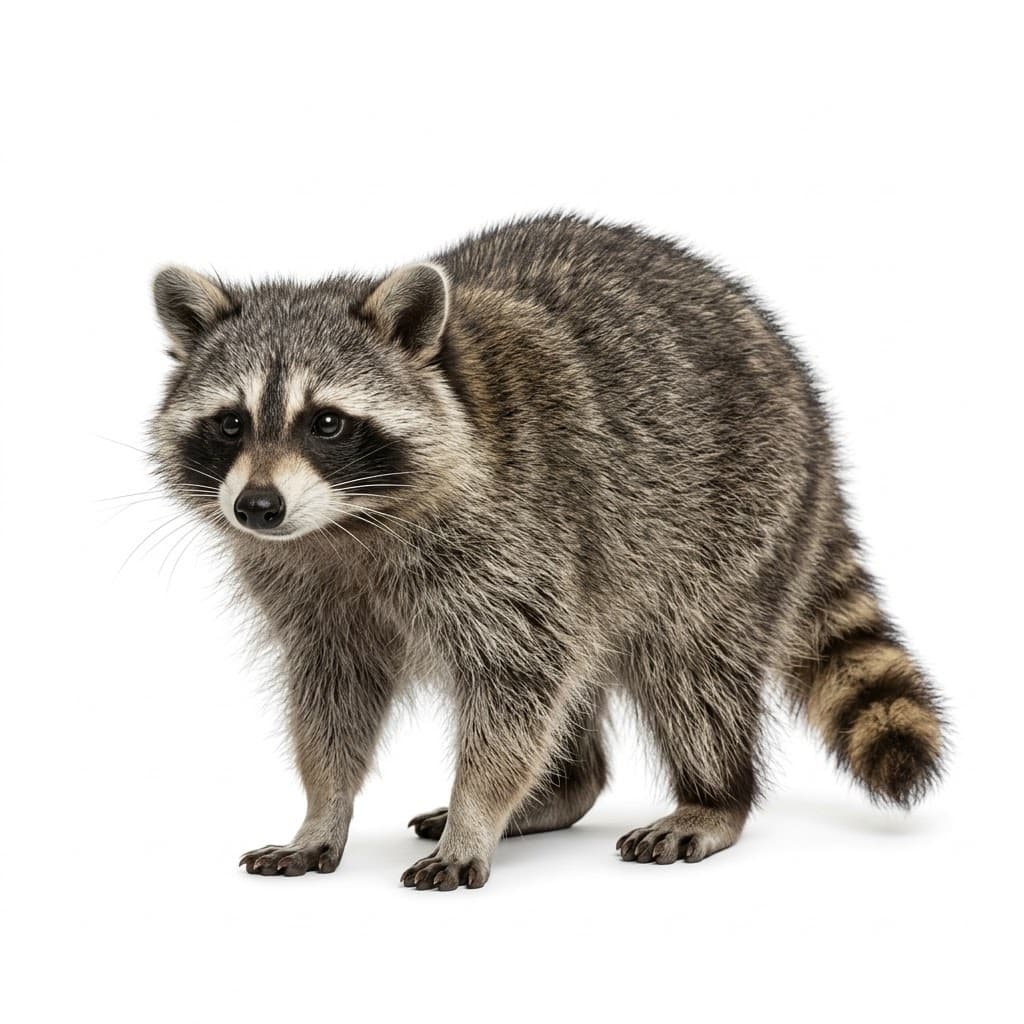
Hands that can "see"
Raccoon paws contain an unusually dense concentration of touch-sensitive nerves — more than those of most mammals. When the paws are wet, their sensitivity doubles.
This is why raccoons often dip food in water. They are not washing it, despite the Latin name lotor, meaning "washer." They are feeling texture, temperature, and shape. A raccoon's wet paws gather more information than its eyes.
A formidable memory
Experiments show that raccoons remember how to solve a problem after three years without practice, an impressive result even compared with many primates. Combine that memory with hands capable of opening boxes, locks, and lids, and you have an animal whose curiosity far exceeds its fear.
Impossible to misidentify
Black fur around the eyes forms a natural "mask," while alternating gray and black rings mark the tail. Raccoons are among the world's most recognizable mammals, though few people know that they come from the damp forests of North America rather than from cartoons.
At ZooJung
The raccoons on Floor 3 have an area filled with interactive enrichment — boxes, locks, and objects to investigate. Watching them test a new object with their paws is one of their most fascinating behaviors.
Observation tip: See whether a raccoon dips its food in water. If it does, you are watching one of the most remarkable touch systems in the mammal world.
📍 ZooJung — 99 Pham Van Dong, Nha Trang
Meet Raccoon every day at ZooJung · 99 Pham Van Dong, Bac Nha Trang Ward