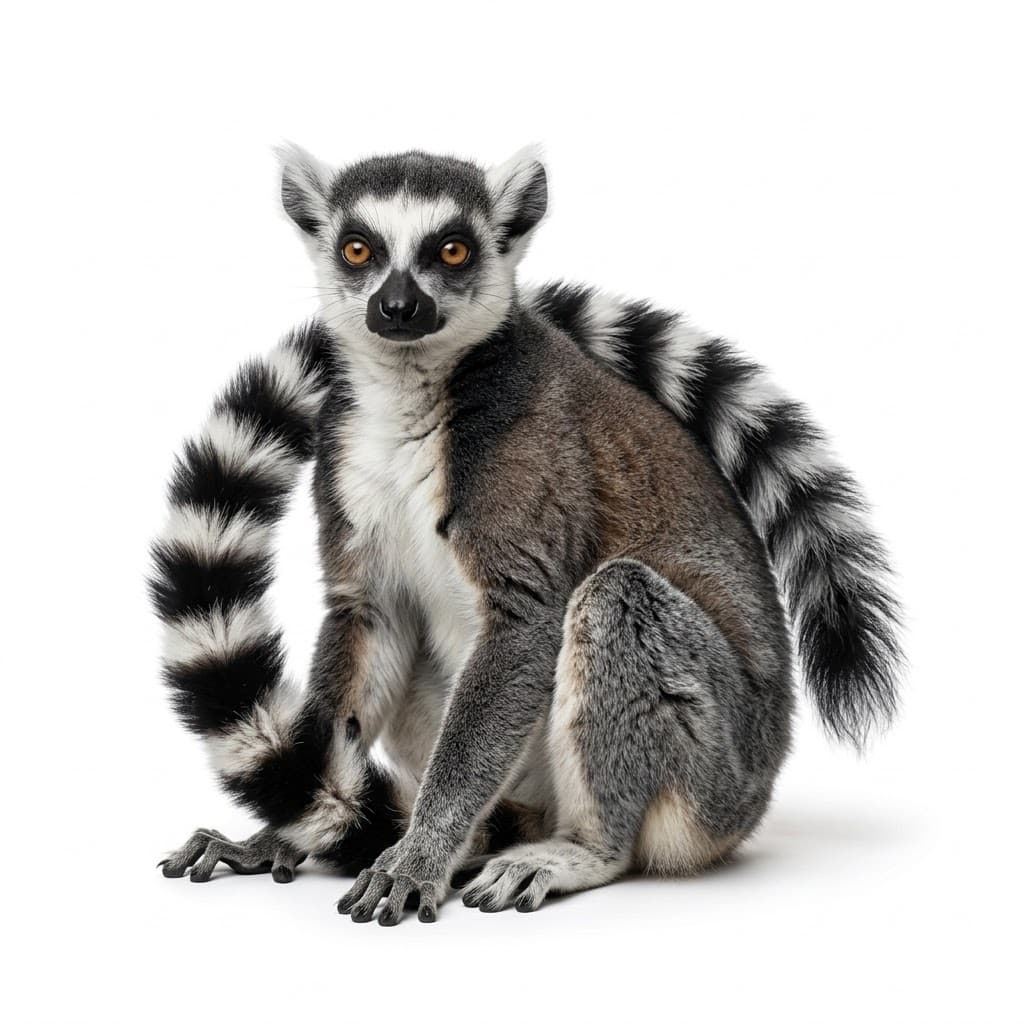
고리꼬리 여우원숭이
Conservation
Endangered (IUCN), CITES Appendix I.
One island, one evolutionary experiment
About 160 million years ago, Madagascar separated from Africa and drifted into the Indian Ocean like a boat cut loose from its anchor. It became completely isolated, with no large predators and no competition from monkeys or apes.
The result was the lemurs, a branch of primates that split from the main evolutionary line more than 60 million years ago, before monkeys appeared. The name "lemur" comes from the Latin lemures, the restless spirits of Roman mythology. The name was inspired by eyes that reflect yellow in the dark and look distinctly ghostly.
Females lead
The ring-tailed lemur is one of very few truly matriarchal primates. Females lead the troop, without exception. They decide where to go, what to eat, and which males may stay.
Every morning, the whole troop sits with arms spread toward the sun. This is not worship; they are absorbing warmth after a cold night. No other primate displays quite the same behavior.
More than a beautiful tail
The tail is longer than the body and marked with thirteen black-and-white rings. It serves as a flag that keeps the troop together in dense forest and as a "weapon" in scent fights between males. A male rubs scent glands on his wrists along his tail, then waves it toward a rival. The stronger smell wins.
At ZooJung
The lemurs on Floor 2 live among branches with plenty of room to climb. They are most active in the morning, especially during their "sunbathing" about thirty minutes after opening.
Observation tip: Count the black-and-white rings on a tail — are there exactly thirteen? Then watch which animal is leading. It is usually the largest female in the troop.
📍 ZooJung — 99 Pham Van Dong, Nha Trang
Meet 고리 여우 원숭이 every day at ZooJung · 99 Pham Van Dong, Bac Nha Trang Ward